How Much Is My Network Like Me? A Mapping Activity
Bonni Stachowiak7 min read
In my first post about my participation in Harold Jarche’s 2026 Personal Knowledge Mastery workshop, I noted that I wasn’t necessarily committed to doing quite the volume of writing that I had done when I participated in this same workshop last year. Given that I have already spent hours today on what would potentially be the first of three posts related to to the content for this week, that reduced aim for this second round of the workshop does not seem to be panning out very well for me.
All of this is so fascinating.
The Shift From Hierarchy to Networks
Most work cultures haven’t kept up with what is needed most in organizations. We continue relying on hierarchy for decision making and getting work done, when Jarche posits that we should instead be emphasizing the power of networks. I see the wisdom in what he suggests both at an individual level, as well as in what our communities need. Jarche goes into more detail about these differences between network-centric and hierarchy-centric thinking and the various ways this sort of thinking “lets us see with new eyes.”
As I consider what my professional network looked like for the first decade of my career vs what it has looked like the past ten years, there are sharp contrasts. I recognize much more the richness that comes from having a diverse network of people who can contribute in various ways to my sensemaking. Harold stresses the importance of networks:
It’s all about networks. Understanding networks that is. This is the shift our organizations, institutions, and society must make in order to thrive in an always-on, interconnected world.
In that same post about networks, he links to a Royal Society of Arts video that explores The Power of Networks. One point they make in the video is that success in complex systems requires knowing enough across multiple domains to make unexpected connections rather than being siloed in a single specialty. That resonates with me, as I continue to reflect on the way my network looks today versus how it did earlier in my career.
RSA ANIMATE: The Power of Networks
Instead of thinking about systems in terms of hierarchical “trees,” we benefit from using a network as our mental model. By mapping nodes and connections within networks of knowledge, people, or systems, we can better understand emergent properties, collaboration patterns, and the flow of information across domains. Not only is this needed within organizations, but I also note that my own network is far more full of people who have knowledge across disciplines, and I’m all that much better for it.
Working Smarter with Personal Knowledge Mastery
Another insight that struck a chord with me had to do with the contrast between collaboration and cooperation. To describe these distinctions, Harold writes:
Note that collaboration happens around some kind of plan or structure, while cooperation presumes the freedom of individuals to join and participate. Cooperation, not collaboration, is a driver of creativity. Cooperation is working together in a networked and non-directed relationship, and is missing in many workplaces today. Much of PKM is focused on cooperation.
Jarche maps this on two axes: goal-oriented collaboration versus opportunity-driven (and creative) cooperation on one, and hierarchical, structured learning versus diverse, unstructured learning on the other.
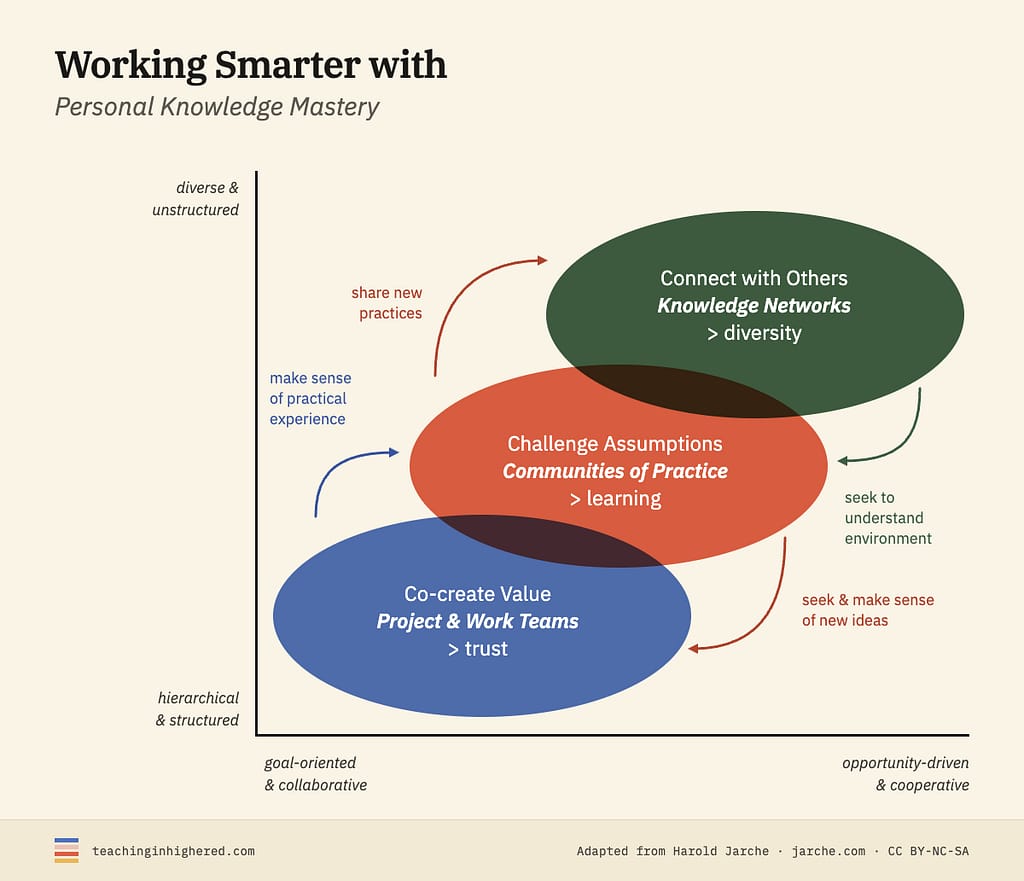
In the past six months, my university work life underwent a reorganization within academic affairs. Many of us who were impacted had grown accustomed to collaborating with each other in fairly structured ways (with high levels of trust). Now, we’re continuing to try to find new ways of being together and even finding new words to describe our changing relationships.
Our interactions now would best be described as existing either within communities of practice, or even knowledge networks (probably both). On some days, I would have clumsily described that as an entirely bad thing. I enjoy collaborating and do very little of it, formally, now at work. As I consider the richness of creativity available to us when we engage in cooperation, I feel a renewed sense of hope, along with a new way of talking about some of these changes.
Network Mapping Activity
In each of the topics that Harold invites us to explore within the PKM Workshop, he offers an activity. The one that relates to this topic was to map out our networks by listing up to four people across seven different questions. Here are just a few of his prompts, to give you a sense of what Harold includes in this exercise:
- Who are the people with whom you have most frequently discussed matters important to you?
- Who are the people you contact when you have a very complex work problem?
- Who do you approach for career/work advice, such as deciding to take or leave a job?
Harold then asks us to count how many different names we have, out of a possible 28 (seven questions with up to four people each). Finally, he invites us to analyze our lists and consider what we might discover in the process.
How Much is My Network Like Me?
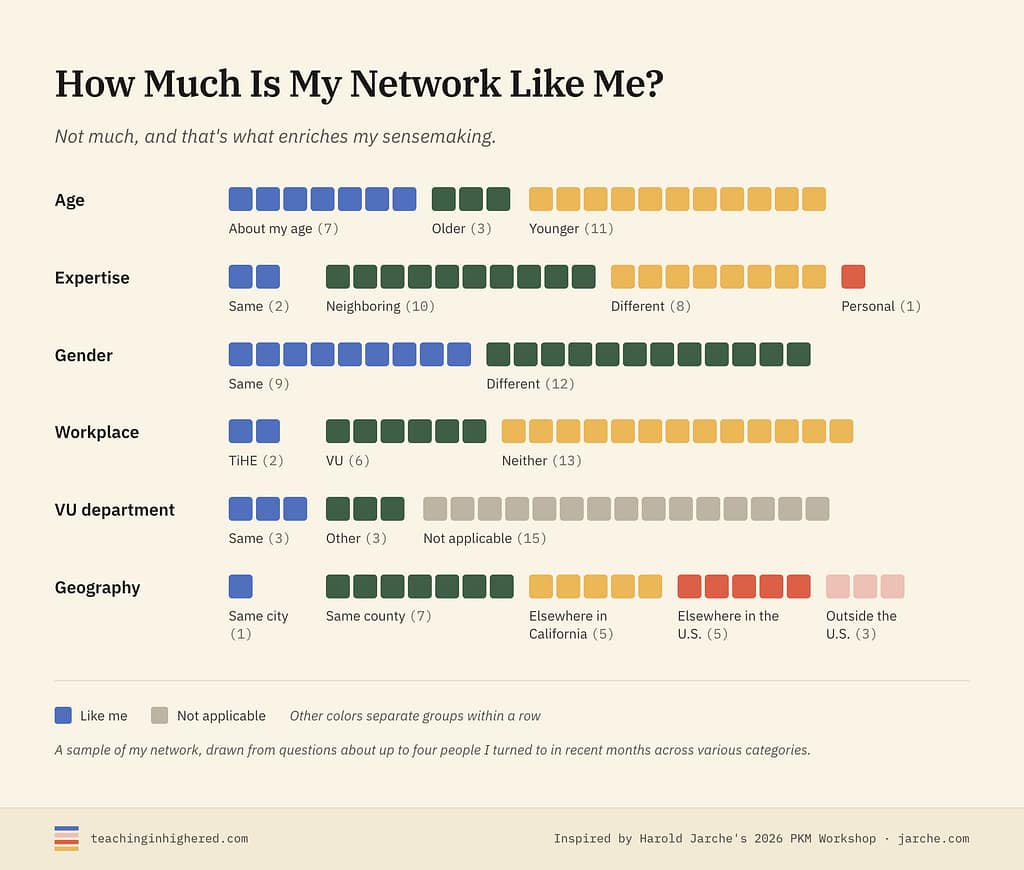
Completing this activity was the part of my day that slipped away from me. I found myself wrestling with the ways that Harold had suggested we might analyze our answers to the seven questions. The biggest confusion is that I don’t really have a single workplace to analyze. My primary place of employment is the university where I work. Yet my husband and I also own a business, which ‘houses’ our two platforms: Coaching for Leaders and Teaching in Higher Ed. I also have a friend/colleague who is both my web designer and developer and who has done work for me/us over the years, including this past summer with the huge TiHE website redesign.
I kept reminding myself that Harold had only been making suggestions and to keep tweaking it until it helped me with my sensemaking. I also kept slowing myself down, as I thought through what I know (and still continue to learn) about charts. I obsessed over the following chart’s subtitle, for example, as I thought back to a course I took from Edward Tufte’s organization and got all distracted, once again.
Given that it is now well past noon and I really need to get to the other two PKM topics and finish my grading for the week (unrealistic expectations, I already realize), I have stopped myself from futzing more and will share a bit more about my observations from this activity.
Diversity
Harold urges us to find ways to make our networks more diverse. I enjoyed seeing that my relationships are far more geographically diverse than they were when I first entered higher education a couple of decades ago. I had left working for an international corporation and didn’t have ways of continuing to build networks with people outside the U.S. at that time. Now, I credit the power of the internet and technology with making this far more possible, not to mention people who lead organizations and associations that facilitate these kinds of connections.
I’m in my mid-50s and certainly do have people in my network who are older than me. However, my husband, Dave, is six years younger than me (so I categorized him as younger), and I found I had to guess a few people’s ages, as I wasn’t sure. I’m not at all worried about the diversity of my network, as it relates to age, but it still was something else to look at the results. 😬
I was very curious about the expertise one. Harold had made this a binary question, asking us to say whether the person was in the same area of expertise as us, or in a different area of expertise. I’m thinking, well, it depends. Not a single person on my list has a single area of expertise. I found myself wondering what the word expertise means anymore…
Yes, I could try thinking about it from an academic standpoint. But I kept flashing back to having read Braiding Sweetgrass: Indigenous Wisdom, Scientific Knowledge and the Teachings of Plants, by Robin Wall Kimmerer, in the last year and considering how limiting academic disciplines are. It was at this point that I thought I really needed to get a walk in and back slowly away from the computer.
What’s Next
I would like to keep thinking about networks and the other ways I might want to analyze mine, beyond this activity. I found limiting the group to just four to be a unique lens to use, yet also as I kept coming back to my wrestling with the idea of expertise, I wished there were a taxonomy to use in stretching the analysis further and being able to consider larger numbers of people. I also was thinking about the one person I classified as “personal” (my mom) when really that only goes to show the stage of life she is in and not the vast knowledge she has cultivated throughout her life.
There are many more opportunities for my learning to come, even just from this week’s topics. Thanks for joining me for this sensemaking adventure. Next, Harold has us looking at curiosity (one of my favorite things in the whole wide world) and communities.
Image CreditS
Photo of litchen (featured image) by Trent Pickering on Unsplash.
Adapted from Harold Jarche, what it’s all about, CC BY-NC-SA 4.0
Chart by Bonni Stachowiak, inspired by the network mapping activity in Harold Jarche’s Personal Knowledge Mastery workshop